
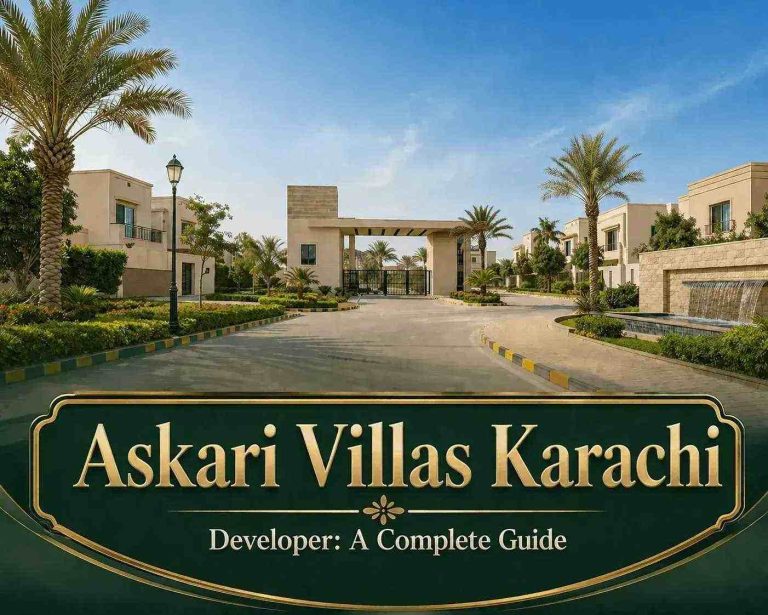
Who’s actually building this? That’s usually the first question buyers ask once the brochures are out of the way. For anyone looking at Askari Villas, getting a straight answer on the Askari Villas Karachi developer structure matters. It’s important to know this before signing anything. Unlike private housing schemes, one company handles everything from buying the land to handing over the keys. Askari Villas runs on a different setup, tied to a long-standing institutional framework, not a conventional real estate firm.
This guide walks through who developed Askari Villas Karachi and which organizations play a role. It also covers what’s actually verifiable in public records and what buyers still need to check before any money changes hands.
Askari Villas Karachi Developer
Who Developed Askari Villas Karachi?
The Askari Villas Karachi developer relies on a cantonment framework instead of a typical private company setup. Askari Villas Karachi falls under the wider Askari brand, and that brand traces back to the Army Welfare Trust (AWT), a welfare organization affiliated with the Pakistan Army. AWT isn’t a typical private developer, and it never set out to be one. It started in 1971 as a registered trust meant to generate income for welfare programs supporting ex-servicemen and their families. Over the decades, it grew into a diversified conglomerate with interests in agriculture, manufacturing, and real estate.
The real estate side of AWT dates back to 1990, when the trust set up a dedicated unit to develop housing schemes in Lahore, Rawalpindi, and Peshawar. More Askari developments followed in other cities afterward. That’s the institutional thread running through the Askari name wherever buyers come across it, including here in Karachi.
One thing worth saying plainly: there isn’t much reliable public information naming a specific in-house project team or construction contractor working exclusively on the Karachi villas. A handful of property websites throw out different names, but none come with documentation solid enough to confirm who’s accurate. Rather than pick one and repeat it as fact, the honest move is to point buyers toward the cantonment authority directly for that level of detail.
Organizations Behind Askari Villas Karachi
Askari Villas Karachi sits within Askari 6 (Askari VI), a cantonment housing scheme near Malir Cantt. A few different organizations share responsibility for how it actually operates:
Army Welfare Trust (AWT), the parent organization behind the Askari brand nationwide. Cantonment Board, the government body handling land records, construction approvals, and ownership transfers under the Military Lands and Cantonments framework. Local Askari colony management offices usually deal with the day-to-day administrative side once residents have actually moved in.
That’s a fairly different setup from how a private developer like Bahria Town operates. There, a single company controls planning, construction, and sales under one roof. With Askari, the cantonment system layers government oversight on top of something you simply don’t get with a fully private development.
Why Does This Structure Matters?
Buyers often assume the Askari Villas Karachi builder works like Bahria Town, but the two follow very different models. Land records and transfers run through a Cantonment Board rather than a private company’s internal system. This means ownership paperwork tends to follow a fairly standardized government process. That doesn’t mean buyers can skip their homework; it just means the paperwork trail is easier to trace back to an official source. Compare that to developments where a private company keeps its own books.
Developer Background and History
The Askari name has been active in Pakistan’s housing sector since the early 1990s. Every Askari Villas Karachi developer decision ultimately traces back to the Army Welfare Trust and the Cantonment Board. which puts it among the longer-running institutional brands in the country’s residential market.
So the brand carries a track record that predates a lot of the private developers currently active in Karachi. But longevity at the brand level doesn’t automatically mean every individual phase has a fully documented history, and Askari 6 is no exception. It’s fair to treat “Askari” as a recognizable, established name. Still, check project-specific details through official channels instead of assuming everything from other cities carries over.
Previous Projects
Askari-branded schemes exist in several major cities, generally known for gated, cantonment-administered communities built around security and planned infrastructure. Because these projects span different cities and phases developed across multiple decades, the details vary exact completion timelines and which entity oversaw construction where. No single public record gathers them all.
The practical point for buyers: a multi-decade brand presence is reassuring. But it doesn’t replace checking the actual approval status, NOC, and construction progress of Askari 6 in Karachi specifically.
Developer Reputation
Among buyers and investors in Karachi, Askari developments tend to carry associations with strict access control, organized planning, and a legal framework rooted in cantonment administration. That reputation comes largely from the institutional nature of the Army Welfare Trust and the Cantonment Board’s involvement, not from anything a sales office is promising this month.
That said, a brand’s reputation isn’t a guarantee for any one project. Karachi has plenty of smaller agencies marketing Askari 6 units, and their claims about pricing or availability don’t always line up. Treat whatever a sales office tells you as a starting point, not the final word.
Development Standards and Construction Quality
People generally describe Askari communities as having paved roads, underground utilities, designated green spaces, and density controls meant to keep congestion in check. None of this is unusual; it’s fairly standard across cantonment-administered housing schemes. It’s broadly in line with what you’d find in Defence Housing Authority (DHA)-style developments too.
What’s harder to pin down are the specifics. No one consistently documents construction materials, structural details, or quality certifications for individual villas in Askari 6 anywhere public. Anyone who wants that level of detail should ask the sales office or cantonment authority directly. It’s also worth having a qualified third party inspect any unit before finalizing a purchase.
Why Does the Askari villas Developer Matters Before Buying?
Developer credibility shapes a lot more than just the purchase itself. It affects how disputes resolve down the line and how smoothly ownership transfers when the time comes. It also affects whether the surrounding infrastructure holds up years later. A project backed by an institutional trust with cantonment oversight generally carries a different risk profile. That differs from a project run by a private company answerable to no one but itself. Still, neither setup lets a buyer skip due diligence.
For Askari Villas Karachi, AWT’s and the Cantonment Board’s involvement gives buyers a documented administrative trail. That matters if legal clarity is high on your priority list. It’s not a substitute, though, for confirming the NOC status, ownership records, and construction progress of the specific unit you’re actually buying.
What Buyers Should Verify Before Purchasing?
Before going ahead with any purchase, it’s worth independently confirming a few things:
Current NOC (No Objection Certificate) status for the specific phase or sector. Ownership records through the Cantonment Board, not just whatever paperwork a sales agent hands over. Whether the unit is an original allotment or a resale, since that changes what paperwork you need. Actual construction progress via a site visit, rather than trusting renderings or glossy brochures. Any gaps between what different sales offices or websites are claiming about pricing and availability.
None of this is unique to Askari Villas, by the way. It’s standard practice for any property purchase in Pakistan, no matter which developer or scheme takes part.
Conclusion
Askari Villas Karachi ties back to the Army Welfare Trust, a decades-old institutional organization behind the broader Askari brand. The Cantonment Board handles everyday land administration under Pakistan’s Military Lands and Cantonments framework. That gives the project a different accountability model than a fully private development. Land records are generally traceable through government channels rather than a company’s internal files. Specific project-level details, exact construction management, and unit specifications still aren’t fully documented anywhere public. So buyers shouldn’t assume brand reputation alone answers every question. The most reliable path forward is direct verification: confirm NOC status, ownership records, and construction progress with the relevant authorities before committing any funds.
Frequently Asked Questions
Q1: Who developed Askari Villas Karachi?
Ans: It’s tied to the Askari brand, backed by the Army Welfare Trust, a Pakistan Army-affiliated welfare organization. That organization has been active in real estate since 1990. Local administration runs through the Cantonment Board system.
Q2: Is Askari Villas Karachi a private developer project?
Ans: Not really, not in the conventional sense. A mix of AWT and Cantonment Board oversight administers Askari projects, following the Military Lands and Cantonments framework.
Q3: What organizations are behind Askari Villas Karachi?
Ans: Mainly two: the Army Welfare Trust, as the parent institution behind the Askari brand, and the local Cantonment Board, which handles land records, approvals, and transfers.
Q4: Does the Army Welfare Trust have experience with other housing projects?
Ans: Yes. AWT’s real estate unit goes back to 1990 and has developed housing schemes in cities including Lahore, Rawalpindi, and Peshawar. Askari developments in Karachi followed as well.
Q5: Should I still do my own research before buying?
Ans: Yes, and don’t skip it. Even with institutional backing behind the brand, verify NOC status, ownership records, and construction progress for the specific unit you’re considering. These details vary, and public sources don’t always fully document them.
Q6: Is Askari Villas Karachi a trustworthy investment?
Ans: Many buyers view cantonment-administered projects favorably because of the extra government oversight compared to private schemes. But trust at the brand level still doesn’t replace due diligence on the specific property you’re buying.